How to write an effective B2B cold email
Cold email isn't dead : you just need to know how to write them
3/10/20264 min read
How to Write an Effective B2B Cold Email
Very few salespeople know how to make effective B2B cold calls, but virtually every salesperson sends B2B emails.
The problem is that many of them have no idea how to write a good B2B prospecting email.
Here are the most common mistakes I see:
Trying to explain their entire offering in a single email.
Sending just one email (or one email followed by three GIFs as follow-ups, each a week apart).
Sending generic messages to thousands of prospects, without any personalization or relevant trigger.
If you recognize yourself in any of these mistakes, sorry to break it to you, but your B2B cold emails probably aren't very good.
Obviously, you shouldn't expect to book one meeting for every two emails you send. However, in cold email prospecting, one meeting for every 100 emails is already a very good ratio.
Don't worry, I'll walk you through the fundamentals: what a good B2B prospecting email looks like (subject line, content, etc.), how often you should follow up within an email sequence, and what results you can reasonably expect from an email campaign.
Multichannel prospecting can also improve meeting quality and help you book more meetings from a given number of prospects.
1. What Is Cold Email?
Cold emailing consists of sending targeted and relevant prospecting emails to decision-makers, with the aim of booking a sales meeting.
The goal isn't to explain your entire offering in a single email. It's to spark the prospect's professional curiosity by sharing just the right amount of information: not too much, not too little.
A) The Email Subject Line
Your subject line should be short and intriguing enough to get the recipient to open your email.
If your email isn't opened, the content you spent an hour writing is completely useless.
A good subject line grabs attention and doesn't look like it's part of an automated sequence or has been sent by a salesperson.
I often use the subject line "hello :)" because it's completely unexpected and generates a lot of opens (80% open rates in my tests).
Another good practice is to summarize the offer contained in your email in very simple terms.
You've probably got the idea by now: no more than 3 words, no capital letters.
You can also plan different subject lines for different emails in your sequence.
B) Email Sequences
B2B cold emailing should never consist of just one email.
Many prospects are away, won't see your message, or simply won't open it.
For those who actually open your email, the message needs to be short enough for them to decide within a split second whether it's worth reading in detail.
That alone won't necessarily be enough to convince them to book a meeting immediately. That's why sending additional follow-up emails is so important.
Once you've sparked their curiosity, they'll be more likely to pay attention to your next emails and may even expect to hear from you again.
You can therefore work on the assumption that, unless someone has explicitly told you they're not interested, they may still be a potential opportunity.
Your follow-up emails shouldn't be sent immediately. Leave at least 2 to 3 days between each message.
Personally, I wouldn't recommend more than 6 follow-ups. I usually stick to around 4 emails per sequence, spread over approximately 2 to 3 weeks.
Sending too many emails risks burning the prospect. After receiving too many unwanted messages, they may develop a lasting negative impression of you.
See here for more information on how to prospect without harassing your prospects.
C) Email Content
A good B2B prospecting email should contain between 50 and 120 words at most.
It should consist of several short, impactful paragraphs. Every word counts.
There's no point writing too much, otherwise the recipient simply won't read your email.
Your message should include social proof (companies you've worked with), demonstrate tangible value, and be personalized to the person you're contacting.
Here's an example of a B2B email I send in my own market. This is the first email in the sequence:
Hi Sebastian,
I noticed that you're offering your web stories platform to Communications Managers. Would you be interested in acquiring more customers in this market?
I've actually worked with around 20 B2B companies, including Realytics and The Coding Machine. I typically generate between 1 and 8 meetings per day, depending on the target audience and market.
In practical terms, this could help you generate a steady flow of qualified meetings and accelerate your business growth. Would you be available for a 20–30-minute video call over the next few days to discuss it?
Best regards,
In this example, my email is personalized because it immediately mentions my prospect's specific offering and the job titles of their target customers.
The recipient can therefore get the impression that I've actually done my research and personally written the email.
That's not the case, since I've automated the entire workflow. But it still has a positive impact and significantly improves the reply rate compared with generic emails.
2. What Results Can You Expect?
You shouldn't expect to book one meeting for every 10 emails you send and then conclude that cold emailing doesn't work when you fail to achieve that ratio.
For the same number of prospects, cold email is generally less effective than cold calling at generating meetings, simply because it's much less impactful and easier to ignore.
In B2B, generating one meeting for every 100 emails sent is already a very good result. It often indicates that your emails are well personalized.
So yes, email campaigns require volume.
It's often possible to send 50 to 100 B2B emails per day manually, but this takes a considerable amount of time.
Since the process is so time-consuming, I've personally automated the writing of personalized emails using an AI-powered n8n workflow. I'll cover this in another article.
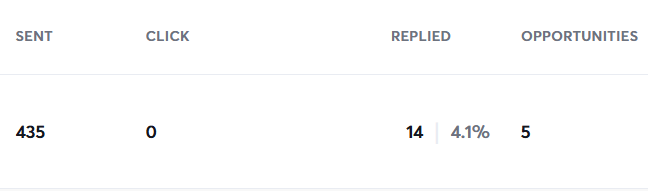
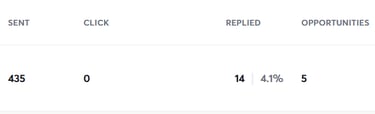
Here are the results I achieved with an automated email campaign using this workflow:
435 emails sent, 14 replies, 5 opportunities.
That's approximately one opportunity for every 75 emails sent.
This excellent result can be explained by the quality of my personalized email sequence, but also by the fact that I prioritized companies with the highest likelihood of converting on my offer.
By scoring my addressable market, I significantly increased the reply rate of my prospecting emails.
Interested in launching an email prospecting campaign in your market? Send me an email at louis@outbound-machine.com