
What's problematic with inbound leads
It's often said that inbound leads are better than outbound leads, but is it always true?
4/18/20265 min read
The Problem With Inbound Leads
The average closing rate in outbound sales is between 5% and 25%. In other words, you need at least 5 qualified meetings to acquire one new customer, and sometimes as many as 15.
This varies significantly depending on your target audience, market, product-market fit, average deal size, and several other factors.
With a good closing technique, it's possible to significantly improve your conversion rate. With inbound B2B leads, the closing rate is generally higher, typically between 20% and 30%.
But is that necessarily better?
Let's take a look at the limitations of inbound.
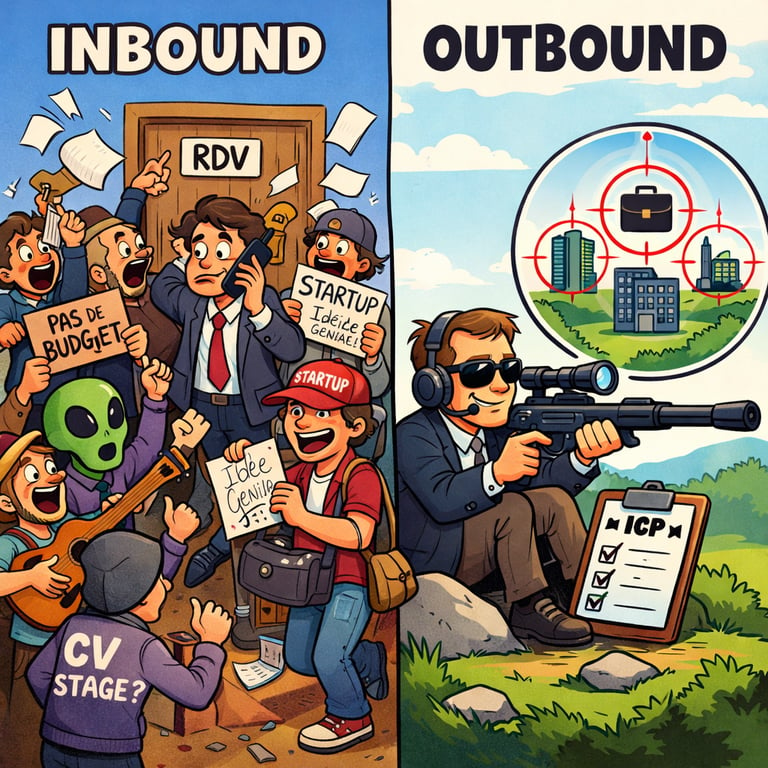
Inbound = No Prior Targeting
That's the whole point of inbound: prospects come to you and book a meeting themselves.
It's certainly an ego boost, but the downside is that you don't necessarily have control over who's actually booking a meeting with you.
For example, with inbound leads generated through Meta Ads, you'll often get huge numbers of completely irrelevant prospects.
Most of your sales efforts will then go towards filtering leads and excluding people who have no budget or aren't even businesses in the first place.
(And there will be plenty of them: often the vast majority of your leads.)
When you include these completely unqualified leads generated through paid advertising, your inbound closing rate can drop as low as 1%.
Leads generated through marketing content, LinkedIn, SEO, and similar channels will generally be more qualified. However, you'll still often get meetings booked by people who don't really fit your target audience.
With my own inbound LinkedIn leads, around 20% to 50% of the meetings booked through my Calendly are with independent professionals outside my target audience, or founders of very small businesses who don't necessarily have the budget.
That's the complete opposite of my ICP: companies with 6 to 20 employees, a decent budget, and some level of outbound sales maturity.
These businesses without sufficient budgets can waste a lot of time trying to undermine your skills and pricing, often by pretending to have competing offers from other providers.
So there's quite a bit of wasted time with inbound leads.
And even when you manage to close a deal and acquire a new customer, it won't necessarily be one of your best potential clients, because they may not fit your ICP.
In my case, this means inbound leads don't always meet my ideal criteria: a sufficiently high average deal value (around €6,000 in lifetime value per customer, sometimes slightly less) and an adequate budget.
This can sometimes limit the duration and quality of the prospecting campaigns I run for them.
Outbound = Targeting & ICP: The Greatest Potential
The best way to approach outbound is to be extremely precise about who you're contacting.
One way to do this is to estimate your Total Addressable Market (TAM) and rank your prospects according to their priority.
Alternatively, you can take a more manual approach and simply build a highly tailored prospecting list, although that takes more time.
Since you control exactly who you're contacting, you can choose the right companies.
And if you choose carefully, you're also selecting the businesses that theoretically have the most to gain from working with you.
See here for more information on how to build a high-quality prospecting list.
For me, this means prioritizing companies with a high average deal value and a sufficient number of employees to indicate that they have a decent budget, but not so many employees that they're already highly structured commercially (or, rather, that they think they are).
As a result, your closing rate can improve significantly, because it's strongly influenced by how confident you are in the value you can bring to your prospects.
For example, when I worked as a full-cycle Business Developer at an adtech startup, I managed to significantly improve my closing rate on outbound leads that I sourced myself.
Simply by researching the product extensively and understanding how it could best address my prospects' needs.
With sales cycles of 3 to 6 months, I managed to generate several dozen new customers, with a closing rate well above 50%.
At one point, I was even closing almost every meeting I generated myself through multichannel B2B prospecting.
So much for industry averages: closing rates aren't fixed benchmarks. It's always possible to achieve significantly better results.
That said, I have to admit that the adtech product I was selling was relatively easy to sell. Even without any particularly sophisticated closing techniques, I was already achieving a closing rate of 20–25%.
When Should You Prioritize Inbound Over Outbound, or Vice Versa?
Of course, I'm not going to write an entirely biased article: in some cases, inbound is significantly better.
Generally speaking, inbound works best when your product has a very broad addressable market and therefore a relatively low price point.
I've already covered this in my article comparing inbound vs. outbound.
For example, many B2B companies have grown through a Product-Led Growth (PLG) model, relying primarily on word of mouth and a bit of advertising.
The ideal setup is a free or very inexpensive software product, with a paid enterprise version or additional features for larger companies.
That's how companies like Notion, Calendly and Slack grew.
However, even these Product-Led Growth companies have sales teams dedicated to targeting enterprise accounts.
That's particularly true for the companies I just mentioned.
See here for more information on why most B2B sales teams underperform.
In fact, as soon as your average deal value becomes sufficiently high, the number of potential buyers decreases, and outbound clearly becomes the best acquisition channel.
The Best Way to Do Outbound: Multichannel Prospecting
As you've probably understood by now, outbound prospecting is often the best customer acquisition channel in B2B.
For low-ticket products, it works best when combined with marketing, allowing salespeople to focus on warm leads.
That's precisely what B2B setting is all about, and it can often generate more meetings than pure cold calling.
With enterprise accounts, however, setting is rarely effective because it's much harder to generate enough warm audience through marketing content.
One alternative is to retarget people who have engaged with your email sequences, for example, prospects who have opened several of your emails.
See here for more information on how to succeed with cold email prospecting, something that's become increasingly rare these days.
Conclusion: Multichannel Is the Best Acquisition Strategy for High-Value Deals
With enterprise accounts, a successful multichannel strategy can replace the traditional setting approach used for small businesses and independent professionals.
In other words, cold calling can primarily focus on warm leads generated through email sequences.
This is the ultimate stage of outbound prospecting, and it's precisely the idea behind the name of my offer: Outbound Machine.
Building personalized email sequences that perform this well takes a bit of time, of course.
If you're interested in this approach and considering outsourcing your prospecting to fill your calendar or generate meetings for your sales team, feel free to book a meeting with me here.